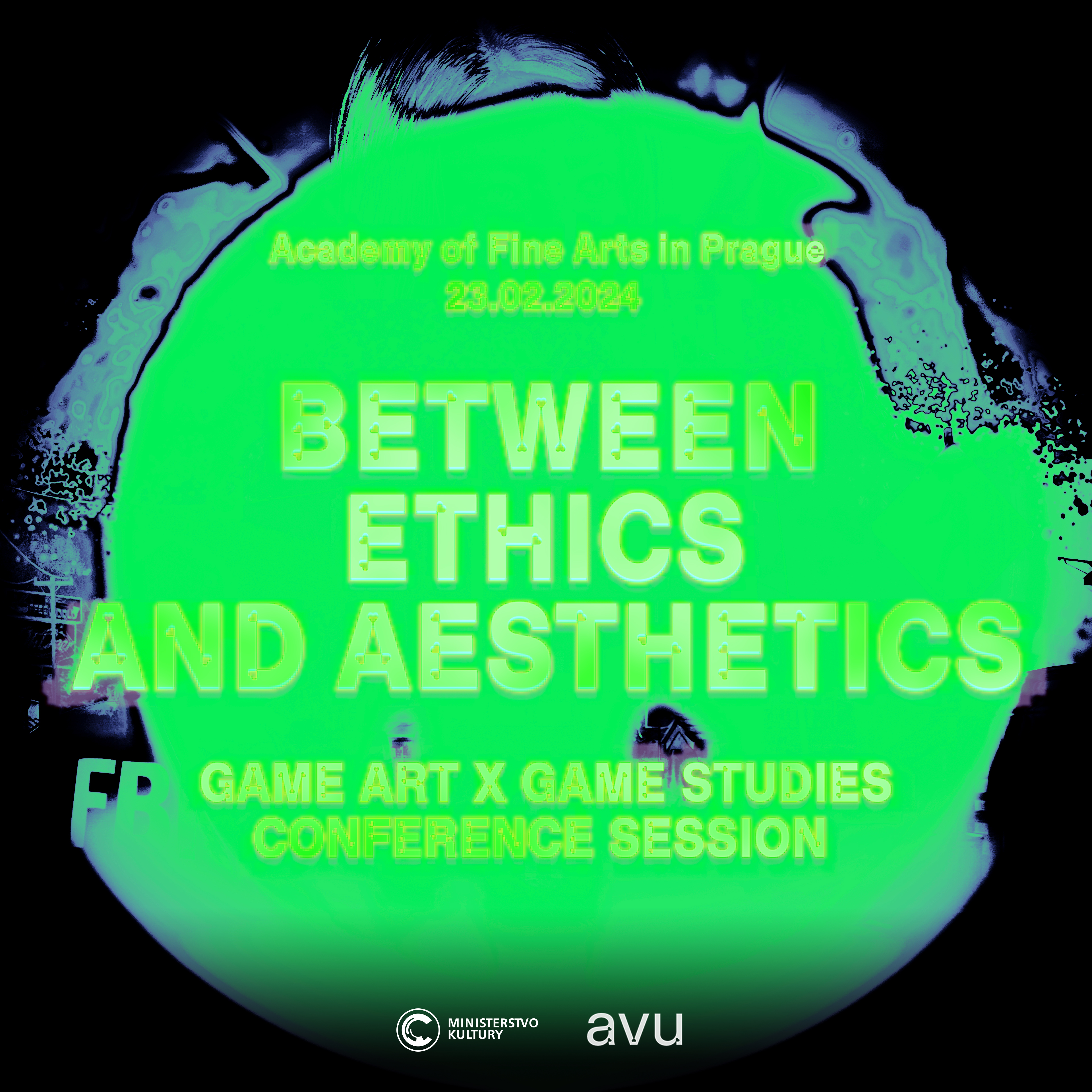
Game Art x Game Studies Conference
Session 23. 02. 2024
Aula / Auditorium AVU
The one-day conference is focused on critical perspectives on game studies and game art, bridging the fields of academic and artistic research. The program consisting of a keynote and a set of 10-minute presentations will investigate the intersection of game studies and critical game art practice. The conference will be held in English without a czech translation. This session seeks to cultivate discourse and collaboration between game studies and critical game art practice. The thematic emphasis, 'Between Ethics and Aesthetics: Gameplay as an Aesthetic Practice,' invites both artistic and academic inquiry into critical topics such as enacting freedom in popular games, the aesthetic experience within player neoliberal subjectivity, player agency, phenomenological perspectives, and the relations between aesthetics and subjectivity.
13:30 |
The reflexive askēsis of gameplay as ethico-aesthetic practice?Dr. Feng Zhu (Keynote) |
14:45 |
Break |
15:00-16:00 |
Cycles of Labour: In the Metaverse, We Will Be HousewivesVeronika Hanáková & Martin Tremčinský |
Self-reflexive games: The Beginner's Guide to their persuasivenessŠtěpán Šanda |
|
Making, studying and playing video games knowing the environmental costsAndrea Hubert |
|
16:00 |
Break |
16:15-17:30 |
A Global Sense of Aesthetic - Human and Machine Approaches to Playing GeoGuessrSusanne Kass |
Does not open from this sideLumír Nykl |
|
LudomancerViktor Dedek |
|
Online Video Game Subjectivity: Between Transgression and RepresentationRokas Vaičiulis |
|
17:30-18:30 |
Concluding remarks |
18:30-? |
After party in Klub AVU |
Speakers
The reflexive askēsis of computer gameplay as ethico-aesthetic practice?
Jane Bennett summarized Foucault’s thinking on the ‘aesthetics of existence’ as proposing that “there is no self without discipline, no discipline that does not also harbor opportunities for artistic practice, and no ethics without aesthetics”. From this, I consider the ways in which players’ self-reflexivity and metacognition – the way in which they bring their own play style to consciousness – can be deemed to be a disciplined attending to their own habituation, one that has ethico-aesthetic stakes.Cycles of Labour: In the Metaverse, We Will Be Housewives
Our videographic essay demonstrates how the simulation of gameplay performatively transcribed into the desktop interface can be used as a strategy to explore and unveil social transformation, in our case the transformation of labour and housework in the recent decades. Daily routines of unpaid, unrecognised, and unseen reproductive labour are captured in the film Jeanne Dielman, 23, quai du Commerce, 1080 Bruxelles (Chantal Akerman, 1975) over a period of three days. Similarly, our videographic essay takes the viewer through three stages in the cycle of the extension of the housewifization (Mies, 1998) into the sphere of the digital. It proceeds from introducing the evolution of reproductive labour, to a playthrough that foregrounds the connections between reproductive and cognitive labour in the datafied society, to a demonstration of how this development of housework turns us all into ‘digital housewives’. Making Jeanne Dielman perform her daily routines in a digital simulation, inspired by the videogame series The Sims, highlights that the heroine of Akerman’s film is not alone in her repetitive endeavours. In the virtual space, we are all becoming digital housewives (Jarrett, 2016). The aim of the paper is to highlight the creative and scholarly possibilities of videographic approach in exploring the current digital dispositif.Self-reflexive games: The Beginner's Guide to their persuasiveness
The rules establish the game. In the case of computer games, they tend to lurk in the background of the other audiovisual layers, with computing power serving as both the basis of rules and as their enabler (Juul, 2003). However, what if some titles highlight this and comment on their nature? These self-reflexive computer games about games fit into many of the existing metagames (Boluk & LeMieux, 2017). They can directly address the player, draw attention to the game system's limitations, or make the rules set visible. It also applies to those implicit, less conspicuous regulatory rules that are not related to the game itself as much as to the context in which the game can take place (Nohr, 2019). How the metagames above draw attention to their nature and regulative rules vary, so they can be studied using a theoretical model based on the means they choose within their persuasive component (de la Hera, 2013). I will outline how some self-reflexive games make their settings visible and attempt to ask questions about the relationship between the player and virtual worlds.Making, studying and playing video games knowing the environmental costs
What is the video games’, and by extension game studies’, answer to the climate crisis? Multiple games, projects, communities and research studies exist at the intersection between video games and environmental issues1. Video games have the power to create opportunities for players to reflect and think ecologically. However, like any other sector, they are themselves entrenched in material reality - from reliance on fossil fuels to e-waste, planned obsolescence and bad work conditions in factories for gaming hardware and harmful practices in material extraction. Video games are unsustainable in their current form. How does knowing the environmental and social costs change our aesthetic experience of playing games? And what about making or studying them? This talk is not about finding excuses in order to regain a clear conscience. Usually, there is no option to make a true ecogame (whatever that means). This talk will be a call to find small ways for accountability, hopefulness and transparency in our daily work. It is an invite to share our worries about the future of video games and digital art and ideas of what every one of us can do.A Global Sense of Aesthetic - Human and Machine Approaches to Playing GeoGuessr
In the browser-based game GeoGuessr, players must use informational and geographical cues to try and pinpoint a location somewhere around the globe based on street view images sourced from Google maps. Though the final stab at the map usually really is a “guess”, many other kinds of environmental knowledge are involved in narrowing down the location to a specific region or country. The global GeoGuessr community have developed a multitude of strategies to locate their guesses using a range of aesthetic and informative semiotic indicators that range from the design of telephone poles to soil colour. However, AI projects have also been developed to guess locations trained on images rather than strategy. Using the biosemiotic theory of Jesper Hoffmeyer, I will consider how the “semiotic technologies” of the human players compare to the “information technologies” used by AI to complete the same task.Does not open from this side
Tracing gameplay tropes such as survival horror backtracking or environmental storytelling & lore in curatorial narration and navigation using selected examples of my own exhibitions curated with Tina Poliačková. Touching upon the notion of the exhibition as a kind of "metroidvania" or environmental puzzle, where new meanings gradually open up in space, via romantic post(irony) and grotesque elements from the tradition of gothic fiction.Online Video Game Subjectivity: Between Transgression and Representation
The aim of the presentation would be to give a concise philosophical outline of the online video game subject, as constituted by the particular technical existence (mode/platform-specific games, etc.). Such a subject is constituted by a dialectic of transgression and representation – a dialectic already present in the alienative constitution of the IRL (“real-world”) subject, here the dialectic is intensified through its mode of URL (“online”) existence. The dialectic would entail a twofold consideration of the following aspects: (1) the relation to culture and economy, and (2) the relation to aesthetics and ethics. The online video game subject is an alienated subject (alienation as formulated by the likes of F. Jameson, S. Tomšič, Laboria Kuboniks) which – on the level of culture – possesses an “eroding cultural identity” and is able to achieve new forms of subjectivity and aesthetic expression, which transgress the IRL world. However – on the level of economy – such a subject is always already representing the late capitalist relations of production and order of norms which are deemed to maximize efficiency and profit (what A. Toscano terms real subsumption). The video game subject, then, is to be seen as both a transgressive subject (aesthetic alienation) and a symbolic-capitalist subject (ethical alienation).Stream
Contact
Visit us:
U Akademie 4/172
170 22 Prague
 Contact person:
 Filip Hauer
filip.hauer@avu.cz
Ondřej Trhoň
ondrej.trhon@avu.cz